Oxy-Fuel Cutting Thickness and Process Plan for S235JR Steel Plate
1. Basic Adaptability of S235JR for Oxy-Fuel Cutting
S235JR is a European standard low-carbon structural steel specified in EN10025. It has a combustion temperature of 1100~1150°C and is perfectly suitable for oxy-fuel (flame/oxy-acetylene/oxy-propane) cutting. It features no hardening or cutting difficulty after gas cutting, making it the most common flame-cut plate for steel structures.
1.1 Applicable Cutting Thickness Range (General for All Oxy-Fuel Types)
| Category |
Thickness Range |
Application Scenarios |
Limitations |
| Minimum viable cutting thickness |
≥6 mm |
CNC / manual gas cutting blanking |
Plates thinner than 6 mm are prone to burn-through and molten edge collapse; laser or plasma cutting is prioritized |
| Cost-effective & efficient range |
10~300 mm |
Steel structures, machinery bases, flanges, heavy plate blanks |
Optimal balance of processing cost and notch stability |
| Extreme cutting thickness |
300~1000 mm |
Heavy forgings, ultra-thick bases (G01-300 heavy cutting torch) |
Slow cutting speed, large heat-affected zone, excessive dross adhesion |
1.2 Comparison of Main Industrial Fuel Gases
- Oxy-Acetylene (C₂H₂) High preheating temperature and fast piercing speed; ideal for thin & medium-thick plates. Drawbacks: low maximum air pressure, weak penetration for heavy plates, relatively high cost.
- Oxy-Propane (C₃H₈) Adjustable high oxygen pressure for stable cutting of ultra-thick plates with low gas unit cost; slightly longer preheating time before piercing. Prioritized for plates over 30 mm.
2. Standard Cutting Process Parameters by Thickness (Compatible with CNC & Manual Cutting)
Table 1 Oxy-Acetylene Cutting Parameters (G01 Series Cutting Torches)
| Plate Thickness (mm) |
Torch Model |
Nozzle Size |
Acetylene Pressure (MPa) |
Cutting Oxygen Pressure (MPa) |
Cutting Speed (mm/min) |
Kerf Allowance (mm) |
| 6~10 |
G01-30 |
No.1 |
0.03~0.04 |
0.50~0.60 |
450~350 |
1.5 |
| 10~20 |
G01-100 |
No.2 |
0.04~0.05 |
0.60~0.70 |
350~280 |
2.5 |
| 20~40 |
G01-100 |
No.3 |
0.05~0.06 |
0.70~0.80 |
280~220 |
3.0 |
| 40~80 |
G01-300 |
No.4 |
0.06~0.07 |
0.80~0.90 |
220~160 |
3.5 |
| 80~150 |
G01-300 |
No.5 |
0.07~0.08 |
0.90~1.00 |
160~100 |
4.0 |
| 150~300 |
G01-300 |
No.6 |
0.08~0.10 |
1.00~1.20 |
100~60 |
4.5~5 |
Table 2 Oxy-Propane Cutting Parameters (Recommended for Heavy Plates)
| Plate Thickness (mm) |
Propane Pressure (MPa) |
Cutting Oxygen Pressure (MPa) |
Cutting Speed (mm/min) |
| 30~60 |
0.04~0.06 |
0.75~0.85 |
240~180 |
| 60~120 |
0.06~0.08 |
0.85~1.00 |
180~120 |
| 120~250 |
0.08~0.10 |
1.00~1.30 |
120~70 |
General Basic Process Requirements
- Standard Flame: Neutral flame with clear flame core, no black smoke or whitened carbonized layer; keep the tip of flame core 1.5~2.5 mm away from the plate surface. Never attach the flame core to the plate to avoid melting the top edge.
- Preheating Time:
- 6~30 mm: 3~6 seconds
- 30~100 mm: 6~12 seconds
- Over 100 mm: 12~20 seconds, until the piercing point turns bright red
- Torch Posture: Hold the torch perpendicular to the plate for straight cutting; tilt the torch backward by 10°~15° for bevel cutting; reduce traveling speed at the cutting end to ensure full penetration at the bottom.
3. Standardized Complete Cutting Process Plans Specially for S235JR
Plan 1 Thin Plate Solution (6~20 mm) – Mass Blanking with CNC Gantry Flame Cutting Machine
- Preparations Remove rust, paint and oil contaminants from steel plates; level and suspend plates to reserve space for molten slag falling; set kerf compensation in CNC programming per the parameter table above.
- Operation Flow ① Ignite and adjust to neutral flame, preheat the piercing point; ② Fully open cutting oxygen after the metal glows bright red; confirm full penetration before constant-speed traveling; ③ For inner hole cutting: drill pilot holes first to prevent tearing at piercing points; ④ After cutting, close cutting oxygen first, then preheating fuel gas.
- Quality Control Heat-affected zone ≤4 mm; no collapse on the top cutting edge; minor bottom slag easy to chisel off; dimensional tolerance ±1.5 mm.
- Applicable Products: Steel structure connecting plates, small flanges, standard machinery bases.
Plan 2 Medium & Heavy Plate Solution (20~100 mm) – Factory Optimal Oxy-Propane Process
- Core Optimization: Adopt propane to raise cutting oxygen pressure, reduce bottom slag adhesion and improve cutting section straightness.
- Key Process Points
- Avoid flameout during long continuous cutting to prevent cutting cracks caused by alternating hot and cold cycles;
- One-time forming of welding bevels for mass production: CNC 5-axis torch synchronized traveling for 30°~45° welding bevels;
- Preheat plates to 80~120°C as a whole under low ambient temperature (<5°C) to avoid cold brittle cracks on cutting edges.
- Post-processing: Remove slag with air picks and grind oxide layers on cut surfaces with angle grinders. No secondary heat treatment is required before welding for low-carbon S235JR without hardened layers.
Plan 3 Ultra-Heavy Plate Solution (100~300 mm) – Heavy Components
- Equipment: G01-300 heavy cutting torch, large-flow oxygen pipeline with stable oxygen pressure ≥1.0 MPa;
- Process Adjustment: Reduce traveling speed, increase preheating flame power and implement sectional preheating; pause briefly every 1.5 m of cutting to fully blow off molten slag;
- Defect Prevention: Long bottom slag trails and striped cut sections are common issues; slightly increase fuel gas flow and extend preheating time to mitigate.
Plan 4 Field Manual Cutting Solution (No CNC Equipment)
- Plates ≤50 mm: G01-100 torch with oxy-acetylene;
- Plates >50 mm: Mobile G01-300 torch with oxy-propane; Note: Expand dimensional tolerance to ±3 mm for manual cutting; leave machining allowance for critical dimensions.
4. Common Cutting Defects & Countermeasures for S235JR
- Collapsed molten top edge: Carbonized flame or flame core too close to plate surface. Adjust to neutral flame and lift the torch by 2 mm.
- Heavy hard-to-remove slag on bottom: Insufficient cutting oxygen pressure or excessive traveling speed. Boost oxygen pressure and slow down cutting speed.
- Flameout & incomplete penetration mid-cut: Clogged nozzle or unstable oxygen supply. Disassemble and clean the nozzle; inspect pressure reducing valves and pipelines.
- Warping & deformation of thin plates (6~10 mm): Reduce preheating flame intensity, adopt segmented short-distance cutting and clamp plates at multiple points.
- Increased hardness on cut surfaces: Rare for S235JR. If occurred, perform low-temperature tempering at 150°C with 30 min holding time after cutting.
5. Thickness Comparison of Oxy-Fuel vs. Other Cutting Methods (Selection Reference)
| Cutting Method |
Applicable Thickness for S235JR |
Advantages |
Disadvantages |
| Oxy-Fuel Cutting |
6~1000 mm |
Lowest cost for ultra-thick plates, simple equipment, usable on site |
Low precision, severe thermal deformation, slow cutting speed |
| Plasma Cutting |
3~40 mm |
Fast cutting speed, smooth cut surface |
High cost for thick plates, incapable of ultra-thick plate processing |
| Fiber Laser Cutting |
0.5~25 mm |
High precision, minimal thermal deformation |
Extremely high processing cost for plates over 25 mm |
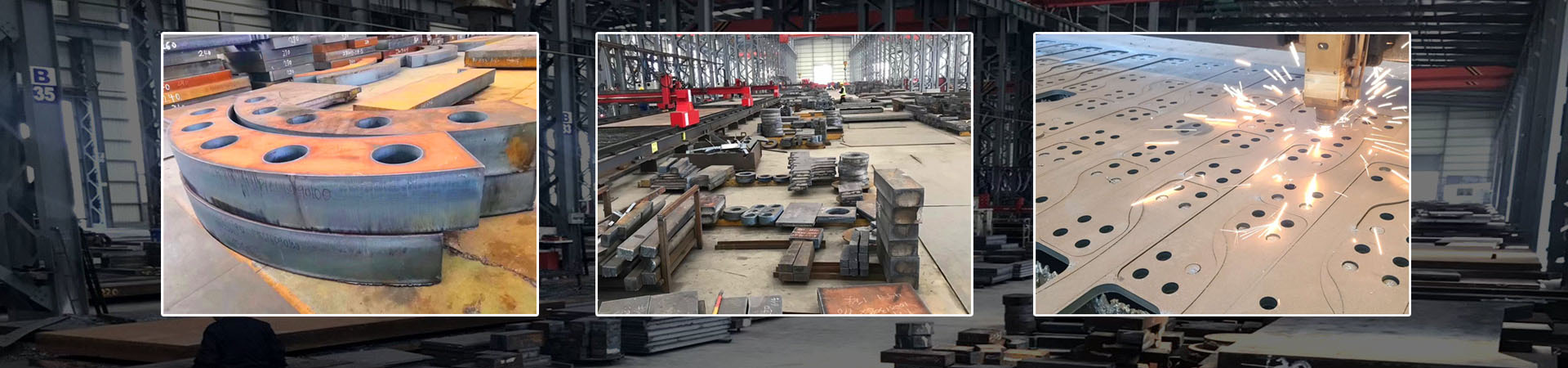
Cutting processing: wear-resistant steel plates (NM360/NM400/NM450/NM500/Mn13), high-strength plates (Q690D/E/S690Q/QL), ordinary plates (Q235B/S235JR), low alloy plates (Q355B/C/D/E/S355JR/J0/J2/K2), carbon bonded plates (45 #, S45C, S50C, bm48c), as well as various special alloy steels from large steel mills such as Wuhan Iron and Steel Group, Liangang, Baosteel, Ansteel, Shagang, Nangang, Hanye, Xingcheng, Yingkou, Ma Steel, etc., as well as Tang Steel, Wenfeng, Ping Steel, etc. The specification is 6MM-500MM thick.
We have good business channels with major steel mills and undertake various types of steel plate OEM processing business. The processing center can cut various supporting materials for engineering machinery, metallurgical equipment, mining machinery, etc. according to customer requirements, such as square plates, circular cakes, flanges, machine side plates, irregular parts, bearing support seats, etc., and process various irregular parts, support seats, machine tool side plates, metallurgical mines, and other supporting materials